Most chat widgets include some version of “contact our team.” Too often, that is where the useful part of the conversation disappears. The visitor explains the situation to the assistant, reaches a boundary, clicks a button, and lands in a blank form. The next person sees a name and email address but not the question that led there.
That is not a handoff. It is a restart.
A good handoff treats the conversation as working context. It gives the visitor a clear explanation of what will happen next and gives the team enough information to continue without asking the visitor to repeat everything. For MoonPress Chat, a WordPress AI chatbot plugin, human takeover is not a fallback link added after the assistant is designed. It is a product state with its own rules.
A handoff begins before the final message
The handoff experience depends on choices made throughout the conversation. If the assistant collects information without structure, hides uncertainty, or keeps pushing for an answer after reaching its boundary, the final transition will feel abrupt.
The assistant should recognize the kinds of moments that require a person. Some are explicit: the visitor asks to speak with someone. Others come from the operating rules: the question needs human judgment, the approved knowledge is insufficient, the request involves an exception, or the conversation has become too sensitive for an automated response.
These triggers should be legible to the team. “Let the model decide” is not an operating rule. A useful system combines clear team-defined boundaries with conversation signals and then records why the transition happened.
Those moments depend on an approved knowledge boundary the team can inspect.
In the 99Legal pilot that informed MoonPress Chat, human takeover and claim boundaries were linked. The assistant was useful only if it could answer routine questions while knowing when it should stop. That same relationship matters for agencies, clinics, consultants, property teams, and other service businesses where a website can explain the ordinary case but a person owns the exception.
Preserve what the visitor already shared
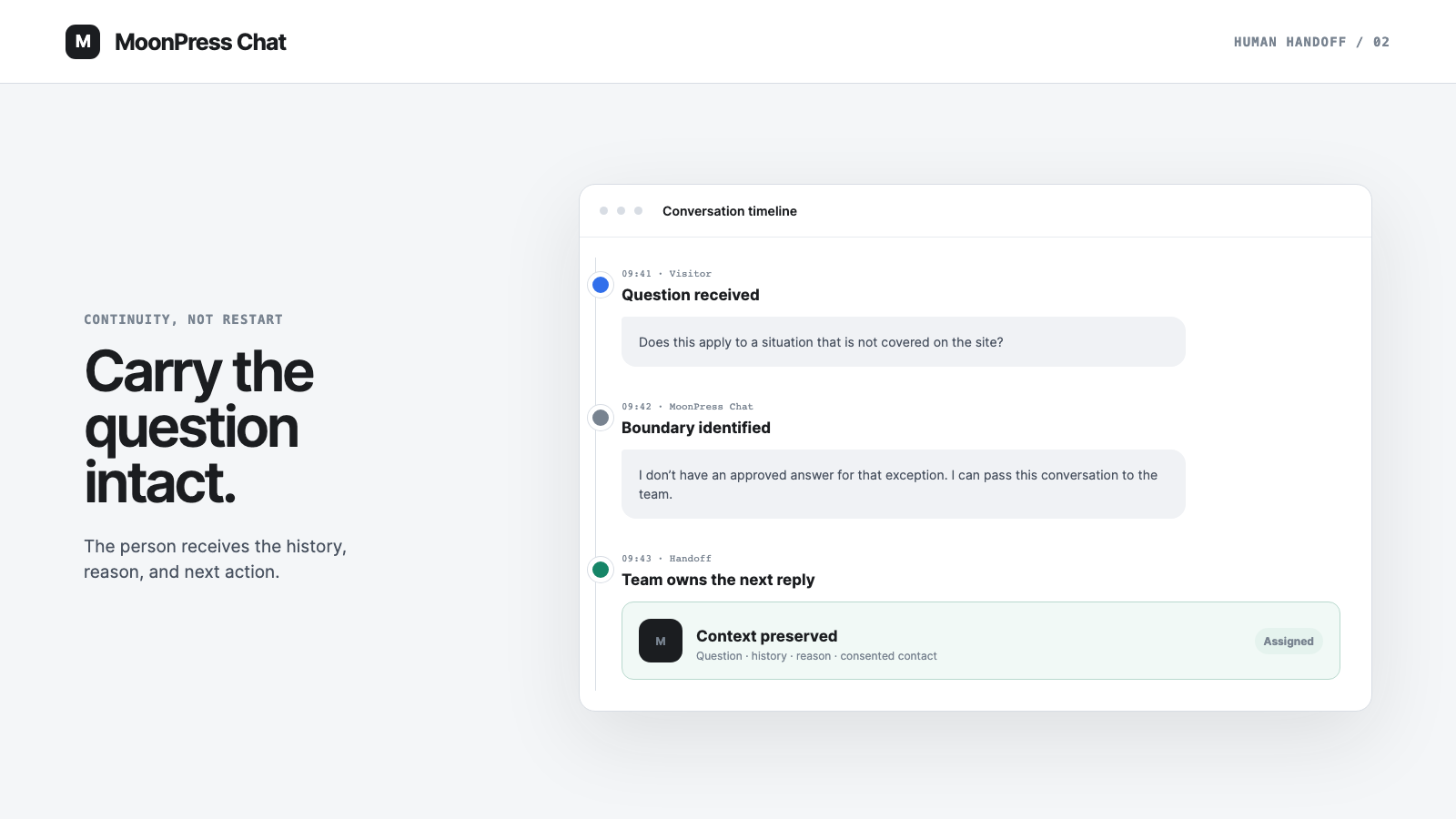
The minimum useful handoff package is more than contact details. It should include:
- the visitor's original question;
- the relevant conversation history;
- any clarifying details the visitor supplied;
- the answer or source that preceded the handoff;
- the reason MoonPress Chat handed the conversation over;
- the visitor's preferred contact detail, collected with clear consent.
This context lets a person enter the conversation at the right point. They can see whether the visitor needs a simple confirmation, a specialist response, or a correction to something on the site.
Preserving context does not mean collecting everything. The product should ask only for information the team actually needs, explain how that information will be used, and respect the site's retention choices. A handoff should reduce repetition without turning a lightweight website question into an unnecessary intake process.
Make ownership visible on both sides
The visitor needs to know when the assistant is no longer the owner of the response. Vague language such as “someone may get back to you” creates uncertainty. A useful transition says that the question has been passed to the team, identifies the expected channel, and avoids promising a response time the business has not committed to.
The internal side needs ownership too. A notification without a clear recipient can become nobody's task. MoonPress Chat's product direction includes handoff and notification controls because different teams route conversations differently. One site may send all handoffs to a shared inbox. Another may route by topic, language, or service line. The launch setup has to reflect the actual operating model rather than an imaginary support desk.
This is also where availability matters. If nobody is monitoring live chat, the interface should not imply a live agent is seconds away. An asynchronous handoff can still be good when it is described honestly and the conversation is preserved.
Let a person continue, not compete
Once a person takes over, the assistant should not keep answering in parallel. Competing voices are confusing and can create contradictory instructions. The system needs a clear state change: automated, waiting for a person, person active, and resolved or returned to automation where appropriate.
The exact states can vary, but the ownership rule should not. At any moment, the visitor should be able to understand whether they are speaking with MoonPress Chat or a member of the team.
A clean state transition also improves review. The team can distinguish questions the assistant handled, conversations that needed human judgment, handoffs that waited too long, and cases where approved knowledge could reduce a future handoff. Those are different product signals and should not be collapsed into one conversation count.
Use handoffs to improve the knowledge system
Handoffs are not only support events. They reveal the edge of the current knowledge and operating model.
If the same factual question is handed off repeatedly, the team can decide whether the website needs clearer content or MoonPress Chat needs an approved answer. If a request always requires judgment, the right improvement may be a faster route to the correct person rather than more automation. If visitors are confused before the handoff, the assistant may need a better explanation of its limits.
This review should remain practical. Teams do not need to turn every conversation into analytics theater. They need enough reporting to find repeated gaps, understand why transitions happen, and improve the source or route that caused them.
The strongest outcome is not “fewer human conversations” at any cost. It is better allocation: MoonPress Chat handles questions that fit approved knowledge, while people receive the conversations where their judgment or authority matters.
A handoff checklist for a WordPress site
Before enabling a website assistant, walk through the complete transition as both a visitor and a team member:
The broader WordPress AI chatbot plugin launch checklist also covers source approval, privacy, language, private testing, and rollback.
- Ask a question MoonPress Chat should answer from approved knowledge.
- Ask a question that sits just outside that boundary.
- Request a person directly.
- Confirm the visitor sees an honest explanation of the next step.
- Confirm the team receives the question, history, reason, and consented contact detail.
- Confirm the assistant stops competing after a person takes ownership.
- Confirm the conversation can be reviewed without exposing more data than the team needs.
Test the flow on mobile as well as desktop. A handoff that works only in a large admin screen is not ready for the visitor who opened chat from a phone.
The conversation is the unit of continuity
The useful object is not the form submission or the final assistant message. It is the whole conversation: what the visitor needed, what MoonPress Chat knew, where the boundary appeared, and who owns the next response.
Designing around that continuity makes the handoff a reliable part of the service instead of an apology. The assistant does not have to pretend it can finish every request. It has to carry the request intact to the person who can.